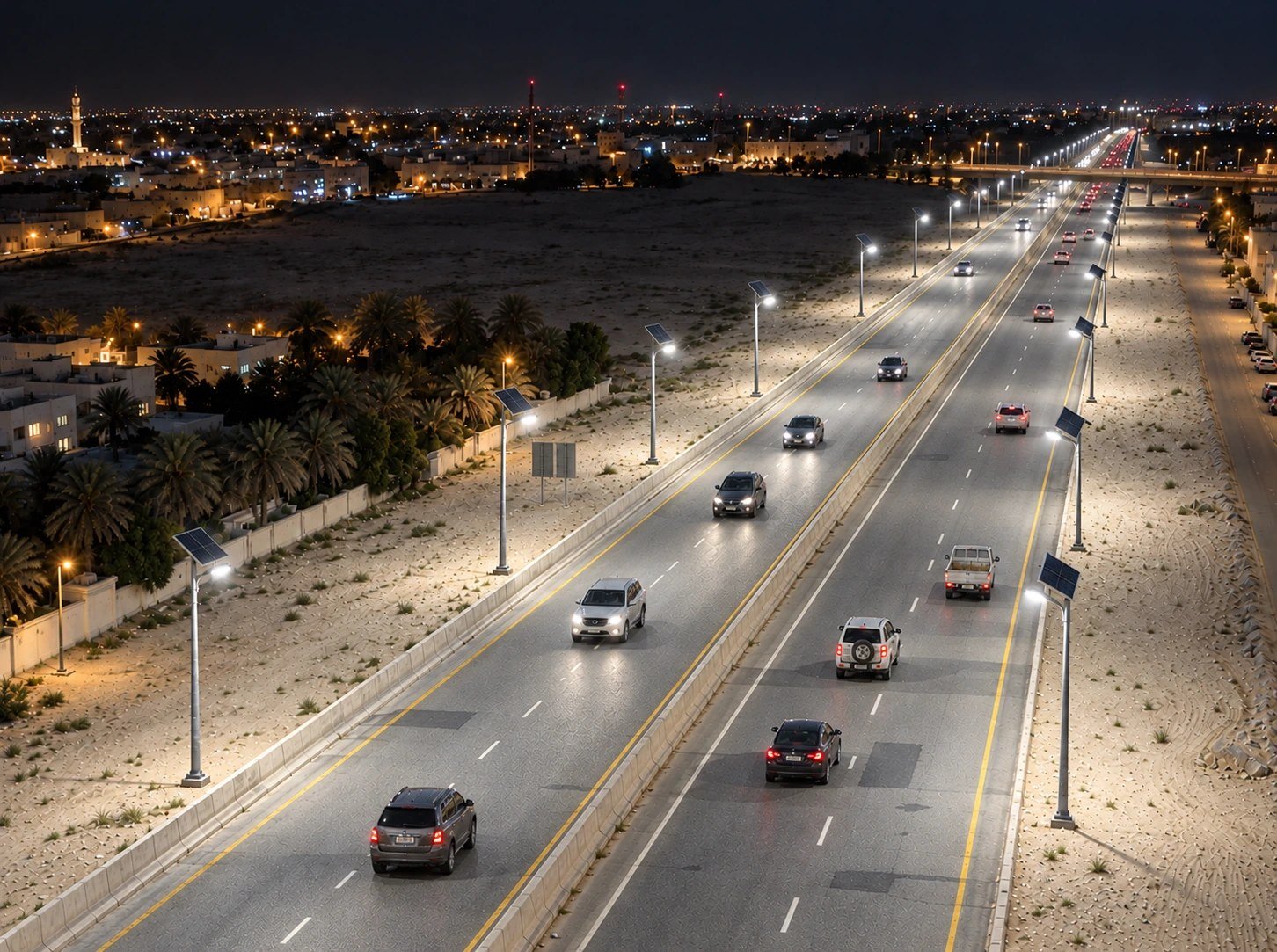
Highways and main roads are the most demanding place to use solar street lighting. Traffic is fast, the light level must be high and even, poles are tall and exposed to wind, and a dark section is a real safety risk. Solar can work very well here, but only when the system is specified with care.
This guide covers the main points road engineers and contractors check before specifying solar street lights for highways and main roads.
1. The Lighting Class Comes First
Every highway project should start with the required lighting class for each section: the average light level and how evenly it is spread. Standards such as EN 13201, CIE 115 or national road codes define these classes. Interchanges, junctions and pedestrian crossings usually need more light than straight sections. Without a clear class, it is impossible to compare offers fairly.
2. A Lighting Design for the Real Road
The road cross-section, number of lanes, median, pole position and mounting height all change the result. A lighting calculation, typically done in DIALux, shows whether the proposed luminaire, height and spacing actually meet the class. It also shows how far apart the poles can be, which often has the biggest effect on project cost.
3. Light Distribution and Glare
On wide roads, the luminaire’s optics matter as much as its wattage. The light distribution must spread light across the full carriageway without wasting it on the verge or the sky. Glare control is just as important: drivers moving at high speed should not be dazzled by poorly shielded fixtures.
4. Power, Battery and Autonomy
Highway lights run at higher wattages, so they need larger solar panels and batteries than residential lights. Engineers check:
- Panel size and orientation for the site’s sunlight in the worst month of the year.
- Battery chemistry and capacity. LiFePO4 lithium batteries are the standard for quality systems, with long cycle life and good heat tolerance.
- Autonomy, the number of cloudy days the system can run without recharging.
- The dimming profile, for example full output during evening traffic and reduced output in the quietest hours, which protects autonomy without leaving the road dark.
For higher wattages, split systems, where a larger panel is mounted separately at the best angle, are often a better fit than compact all-in-one units.
5. Poles, Wind and Foundations
A solar pole carries a panel as well as a luminaire, which adds wind load at the top of a tall pole. Pole wall thickness, galvanising, base plate and foundation must be designed for local wind speeds and soil conditions. On highways, the pole position also has to respect safety rules, such as distance from the carriageway or the use of crash barriers.
6. Heat, Dust and Corrosion
Many highways cross hot deserts, dusty plains or coastal areas. Heat shortens battery life, dust reduces panel output and salt air attacks metal. Specifications should cover operating temperature, ingress protection (IP65 or higher), impact protection (IK08 or higher) and corrosion protection for poles and fixings.
7. Proof, Not Promises
Before approving a product, engineers ask for evidence: photometric files for the exact luminaire, lighting calculation reports, battery and panel datasheets, test reports from recognised laboratories, warranty terms and references from similar road projects. Manufacturers that specialise in solar street lighting for highways and main roads can usually provide this documentation as part of the offer.
8. Maintenance on a Live Road
Every visit to a highway pole needs traffic management, so maintenance should be rare and planned. Sealed, high-quality components, remote monitoring where budgets allow, and a scheduled battery replacement plan keep visits to a minimum.
Final Thoughts
Solar street lighting on highways is no longer an experiment. Many countries now light main roads and interchanges with solar, especially where the grid is far away or unreliable. Success depends on engineering: the right lighting class, a proper design, honest system sizing and equipment built for tall poles and harsh climates. Choosing German-engineered solar street lights with full documentation is one way project teams reduce risk on these demanding roads.