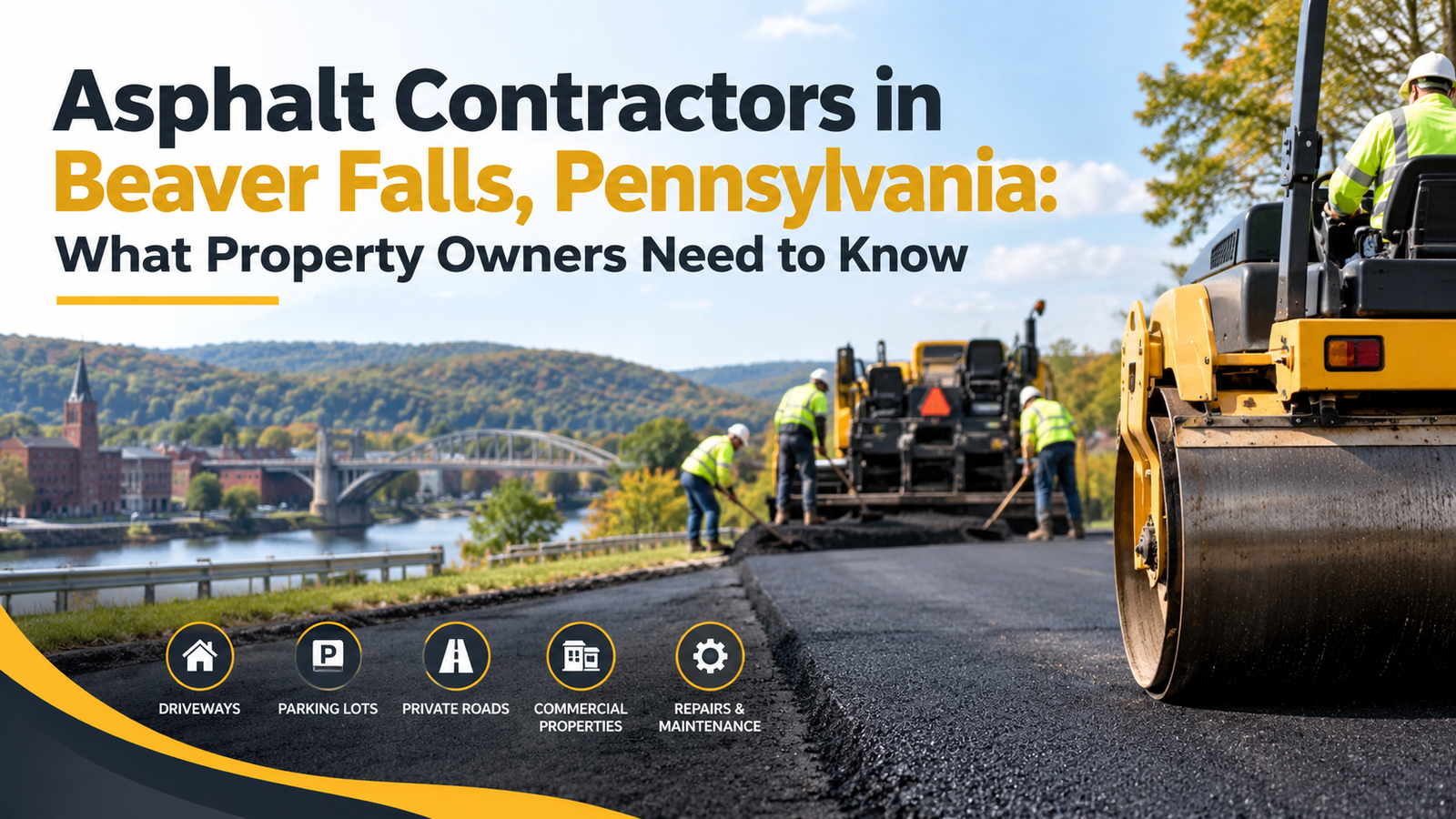
Beaver Falls sits in the Beaver River valley in Beaver County, about 28 miles northwest of Pittsburgh along the US-11 corridor. The city’s topography a valley floor flanked by steep hillside residential streets climbing above the river creates paving challenges that are genuinely distinctive within the Pittsburgh metro region. Driveways that must handle significant grade changes, streets that collect water running off hillside lots, and a subsoil profile of heavy clay and silt that behaves very differently in wet and dry seasons all shape what asphalt installation and maintenance looks like in Beaver Falls. Add the region’s aggressive freeze-thaw cycle the temperature in January and February commonly crosses the 32-degree mark 50 or more times in a season, earning the local Seventh Avenue a reputation for looking like a lunar landscape by March and you have one of the more demanding pavement environments in western Pennsylvania.
Understanding what Asphalt Contractor Beaver Falls actually do in Beaver Falls, what makes pavement succeed or fail in this environment, and what the maintenance cycle looks like for property owners throughout Beaver County gives residents the foundation they need to make good decisions about their driveways, parking lots, and other paved surfaces.
How Beaver Falls’ Climate and Soil Shape Every Paving Decision
The freeze-thaw dynamic in Beaver Falls is the defining factor in asphalt performance throughout the region. When water enters a pavement crack during a rain event or snowmelt and the temperature then drops below freezing, that water expands by roughly nine percent as it converts to ice. The expanding ice forces the crack walls apart, widens the void, and progressively pumps water deeper into the aggregate base. Over 50-plus freeze-thaw cycles in a single winter, this mechanism can take a minor surface crack and turn it into a structural failure that requires far more than surface repair to address.
What makes Beaver Falls particularly susceptible is the combination of the freeze-thaw frequency with the valley’s cold-air pooling effect. Cold air drains downhill and settles in low-lying areas, so the valley floor in Beaver Falls often experiences harder freezes and more temperature transitions across the 32-degree threshold than the surrounding hilltops. A “frost advisory” for Beaver County may translate to an outright freeze on the valley streets and driveways. This is a local climate reality that directly affects how many damage cycles a paved surface experiences each winter.
The soil is the other major factor. Beaver Falls area soils are predominantly clay and silt materials that expand when saturated with moisture and contract when dry. This shrink-swell behavior creates movement beneath a pavement structure that puts stress on the asphalt above, independent of any freeze-thaw action. A driveway installed over poorly managed clay subgrade will show surface cracking driven by soil movement even in seasons when freeze-thaw isn’t the primary culprit. Additionally, clay drains slowly water that infiltrates the base of a pavement section doesn’t escape quickly, leaving the base in a saturated, load-intolerant condition for extended periods after rain or snowmelt events.
Beaver County also receives approximately 36 to 40 inches of annual precipitation, much of it concentrated in the late winter and spring months when the ground may be transitioning from frozen to thawed. This combination of significant moisture volume and slow-draining clay subgrade makes drainage design one of the most important elements of any Beaver Falls paving project. A driveway that doesn’t shed water efficiently, or that directs water toward the house foundation rather than away from it, is accelerating its own deterioration every time it rains.
What Asphalt Contractors Provide in Beaver Falls
Professional asphalt contracting in Beaver Falls covers the complete lifecycle of asphalt pavement from initial site assessment and base preparation through finished surface installation, sealcoating, crack sealing, and eventual resurfacing or reconstruction. Each phase matters, and the quality of work at each step determines how the next phase performs.
Site preparation and base work is where driveway quality is really determined, even though it’s the part property owners see the least of. Before any asphalt is placed, a qualified contractor assesses the subgrade, strips organic topsoil, installs the appropriate depth of compacted aggregate base (typically 4 to 6 inches for residential driveways in Beaver County), and establishes the drainage grades that will direct water away from the structure and off the paved surface. In Beaver Falls’ clay soil environment, skimping on base depth or compaction is what produces early failures driveways that crack, heave, and develop potholes long before they should. Contractors who rush this stage and go straight to asphalt placement are setting the surface up to fail.
Asphalt placement uses hot mix delivered from a plant at between 275 and 325 degrees Fahrenheit and spread by a paving machine at consistent depth. Residential driveways in Beaver Falls typically receive 2 to 3 inches of compacted hot mix asphalt over the prepared base. For the region’s climate, the asphalt mix should use a binder grade appropriate for Pennsylvania’s temperature range the Pennsylvania Department of Transportation’s specifications provide guidance on binder grades appropriate for different climate zones, and contractors working in western PA should be sourcing mix designs that account for both the summer heat softening and winter low-temperature cracking resistance needed in this region.
Compaction is the final critical installation step. Asphalt must be rolled with appropriate equipment while it’s still within the temperature window that allows particles to consolidate properly. Under-compacted asphalt has higher air void content it’s more permeable to water, more susceptible to early oxidation of the binder, and structurally weaker under load. In Beaver Falls, where water infiltration is the primary cause of long-term failure, a well-compacted surface that resists water entry from the start is the foundation of driveway longevity.
Maintenance services sealcoating, crack sealing, and pothole repair extend the useful life of Beaver Falls driveways significantly when applied on the right schedule. Sealcoating every 3 to 5 years protects the binder from UV oxidation and surface water infiltration. Crack sealing before winter closes the pathways that freeze-thaw cycling would otherwise exploit. Pothole repair using full-depth methods (not cold patch) addresses the localized failures that develop before they spread. These services are not optional extras in Beaver County’s freeze-thaw environment, consistent maintenance is the difference between a driveway that lasts 20 to 25 years and one that needs reconstruction in 10.
Hillside Driveways in Beaver Falls: The Local Challenge
A significant portion of Beaver Falls’ residential properties sit on the slopes above the valley floor, and hillside driveways present specific challenges that flat-terrain paving doesn’t. Water flowing down a steep driveway at velocity can erode the asphalt edge at the base of the grade, carry fine base material away through drainage outlets, and concentrate at the garage entrance in volumes that the foundation drainage wasn’t designed to handle. On steep slopes, asphalt mix design matters more polymer-modified binders help resist the shear stress that vehicles create when braking on descents and accelerating on ascents, reducing the surface rutting that plain binder grades can develop on consistently used steep driveways.
Drainage management on hillside Beaver Falls driveways should include catchment at strategic grade breaks, channel drains or French drains where water concentrates, and edge treatment that prevents water from undercutting the asphalt margin. These features are most economically installed during the initial paving project, not retrofitted after failures have already developed.
Commercial Asphalt in Beaver Falls
Beaver Falls’ commercial base along Seventh Avenue, the Route 18 corridor, and the various commercial properties serving the surrounding Beaver County communities includes retail, restaurant, and service businesses whose parking lots handle daily vehicle traffic and periodic delivery and service vehicle access. Commercial parking lots in Beaver Falls must account for heavier vehicle loading than residential driveways, require ADA-compliant accessible space configuration and striping, and benefit from pavement sections sized appropriately for the actual vehicle mix that uses the facility.
Line striping on commercial lots in Beaver Falls must meet Pennsylvania’s ADA standards for accessible parking: correct number of accessible spaces based on total lot capacity, proper dimensions, maximum 2-percent cross-slope in any direction within the accessible space and access aisle, and compliant signage. Commercial property owners in Beaver Falls who haven’t updated their accessible parking configurations to current standards carry real liability exposure, and paving projects are the natural opportunity to bring these facilities into compliance.
Common Questions About Asphalt Contractors in Beaver Falls
Why do Beaver Falls driveways seem to fail faster than those in other regions? The combination of the valley’s cold-air pooling (which intensifies freeze-thaw cycling), heavy clay subsoil (which moves with moisture and drains slowly), and significant annual precipitation creates one of the more demanding pavement environments in western Pennsylvania. Driveways that might last 25 years elsewhere need more proactive maintenance in Beaver Falls to reach that lifespan.
What is the best time of year to pave a driveway in Beaver Falls? The paving season in western Pennsylvania typically runs from late April through October, when ground temperatures are consistently above the 50-degree threshold needed for proper asphalt placement and compaction. Summer and early fall are the busiest periods. Late-season paving is possible but requires careful temperature monitoring asphalt placed when ground or air temperatures are dropping toward the mid-40s needs accelerated compaction before heat loss compromises the rolling window.
How do I know if my Beaver Falls driveway needs resurfacing or full replacement? The key question is whether the base is still structurally sound. Look for alligator cracking the interconnected polygon pattern that signals base failure in addition to surface cracking and oxidation. Press on deteriorated areas with your foot: sound base feels rigid; failed base feels soft or springy. Surface-only distress without base failure is a resurfacing candidate. Widespread alligator cracking, depression, or soft areas indicate that reconstruction is needed.